
And now for something completely different…at least that’s how we felt when we got to Buenos Aires. After weeks of traveling through rural, open spaces the city was a bit of a shock to the system!
We had originally planned to stay in Buenos Aires for a week, but that week turned into nearly two after we decided to get visas for Brazil in case we wanted to cross the border later in our journey (we did not want to repeat the Bolivia experience!). This entailed several trips to the consulate and a lot of paperwork, but as in all bureaucracies, the main hassle is the waiting. Luckily it just meant we got to spend more time in a great city!
Buenos Aires is huge – over 17 million people in the city proper – and has a very European flavor (it is known as the “Paris of South America” for good reason!). Parks and wide tree lined streets periodically break up the density, black and yellow taxis swarm the streets, cafés and bakeries are on every corner, apartment blocks are detailed with mansard roofs, decorative moldings and swirling Art Nouveau ironwork balconies. It also has its share of shiny new buildings and shopping centers and road construction. It is definitely the most cosmopolitan place we’ve visited so far in South America. It is also hot as Hades in summer, but once we got used to it (and exchanged the trekking gear for some summer digs) we enjoyed ourselves!

When in a city, one does city things, so we spent a lot of time walking, eating, drinking, shopping and otherwise soaking up the Porteño experience.
Of course a visit to Buenos Aires would not be complete without experiencing some tango. We had a great introduction to the scene via a friend of a friend named Joan, an expat living in Buenos Aires and a passionate tango devotee. She took us to her favorite milonga (tango dance party) at a club called El Beso (the kiss!) and explained the intricacies of the dance and culture as we sat back and observed. Tango is not only complicated from a technical standpoint, but also has a lot of etiquette regarding choosing dancing partners, how to interact with others on the dancefloor, when to start and stop with the music, and so on. As an anthropologist Sam was fascinated, while Steph tried to decipher the dance steps from the sidelines. Both of us were completely intimidated and stuck to our seats.
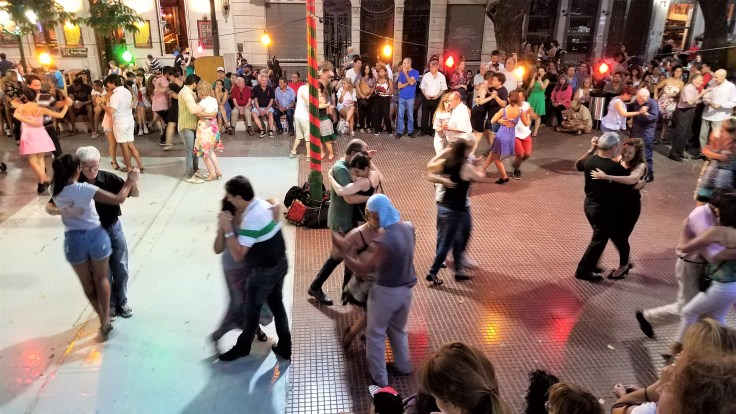
Later in our stay we saw more tango in San Telmo plaza and a restaurant in La Boca (they have milongas and performances all over the city in all kinds of venues). Unfortunately, we never made it to a tango class – all of the beginner classes seemed to be at times when we had other things scheduled, and we weren’t about to go to one of the mixed classes after we knew how complicated it was! That is certainly one regret that we may have to fix sometime in the future.


Like all major cities Buenos Aires is full of parks and museums and neighborhood treasures. A few of our favorites were the bares notables (notable bars), historic cafes designated as historic places by the city (for more info see https://turismo.buenosaires.gob.ar/en/article/historic-cafes). Most still have their original wood paneling and stained glass and waiters with white aprons and paraphernalia from days past cluttering the walls. Some are very touristy, and some are low key. We tried to visit as many as we could!
The city also has amazing markets (ferias). Some are housed in permanent historic structures with handsome cast iron trusses and concrete floors lined with butcher stalls and coffee shops. Others have more of a flea market feeling – on weekends the plazas and streets throughout the city are taken over by vendors selling everything from underwear to craft jewelry. In particular we loved the Feria San Telmo which stretches from the downtown core all the way to the barrio of San Telmo, one of the oldest parts of the city. This area is known for its antiques, and in addition to the street vendors we browsed numerous antique shops and galleries full of fascinating junk. We decided if we were interior decorators this would be a paradise! We also found a set of pink marble dominos from Italy at one stand to add to our collection. We now have Argentina bones!


Another favorite was the Recoleta Cemetery, a city block filled with a mix of gothic and modern and art deco-inspired mausoleums where Argentina’s important historical figures, and others whose names have been forgotten, are laid to rest. Most visitors come to see the tomb of Eva Peron, the popular progressive first lady from the 1940s. However, we were most fascinated by the tombs that have been abandoned – some literally had broken coffins with bones sticking out!


We spent a fair amount of time wandering through the city parks and plazas where we could people watch and take breaks from the heat in the shade. When that got tiring we went into the city museums. Two that stand out are the Museo de Arte Latinamericano (MALBA) and the Museo de Arte Moderno (MAMBA). The MALBA had a visiting exhibit of 20th century Mexican art that was fabulous – it’s always awesome to see original Riveras and Khalos and Posadas! The MAMBA had been entirely dedicated to works by the Chinese dissident artist Ai Weiwei, whose art we didn’t particularly love from an aesthetic standpoint but is compelling for its cultural commentary. Both museums also had excellent cafes with healthy food (hummus! kale salad!) and cool modern architecture and exhibit spaces.


When in Argentina one must eat steak, and we certainly ate our share. Here they serve it parilla (grill) style, essentially cooked over coals or open flame, seasoned only with salt, and in portions that make Texas look tame (fun fact, Argentinians put away over 100 pounds of beef per person per year, way more than us Americans!). Also popular is the mixed parilla which comes served on a tableside grill and could feed a small army (no joke, the pile of meat in the photo below is what they call parilla for two!). Other popular foods we tried were the milanesa (breaded meat covered in cheese and tomato sauce), empanadas (savory stuffed pastries), chori (chorizo on bread with herb sauce called chimichurri – our favorite!) and the ubiquitous pizza. According to one tour guide we spoke with nearly half of Buenos Aires is descended from Italian immigrants, so Italian food has basically been adopted as regional cuisine. You might also notice a lack of vegetables in these meals (we certainly did!), despite the fact that they have lovely produce markets all over the city. Thankfully, we stayed in an Airbnb and were able to find some balance with homemade salads and greens.


We also ventured outside the city and visited the town of Tigre about an hour north of Buenos Aires where the massive Paraná River coming from the jungles of Brazil and Paraguay meets with several smaller rivers and flows into the Atlantic Ocean. It is riddled with small, silty islands, some natural and some man made by dredging through the sediments deposited by the rivers. Small permanent communities and vacation shacks dot the islands, which are only accessible by water taxi or personal watercraft. We spent an afternoon touring the islands on a small motorboat operated by some young Porteños who grew up visiting the delta and come here every weekend to waterski and cool off in the muddy water. It was a blast!


Eventually the visas came through and we had to move on to other destinations. Buenos Aires is definitely a world class city and we barely scratched the surface. We would be happy to return on a future South America trip!

 Bones Without Borders
Leave a comment